
1. Introduction: The Rigid-Flexible Composite Paradigm in Geotechnical Engineering
In modern geotechnical engineering, 邊坡穩定, and terrain erosion control, conventional rigid earth-retaining structures—such as cast-in-place reinforced concrete walls—often face long-term serviceability challenges. These include vulnerability to brittle cracking from differential ground settlement, dangerous buildup of hydrostatic pressure behind the wall, and the ecological severance of the riparian/slope environment.
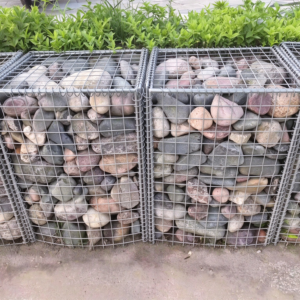
Welded Wire Mesh Gabions (Welded Gabions) have emerged as an engineered, modular retaining and revetment system. Fabricated from high-tensile, low-carbon steel wire or zinc-aluminum alloy wire (加爾萬, typically 90% Zn + 10% Al or 95% Zn + 5% Al) via precision electrical resistance welding, these wire cages are assembled on-site and packed with dense, graded angular stone aggregate.
Evaluated across Geomechanics, Hydrodynamics, and Bio-Geotechnical Engineering, welded gabions represent a monolithic yet flexible solution that integrates earth retention, pore pressure relief, settlement tolerance, and ecological restoration.
2. Geomechanical Mechanics & Structural Stability
+-------------------------------------------------------------+
|               GEOMECHANICAL FORCE EQUILIBRIUM                |
+-------------------------------------------------------------+
       Retained Backfill (Soil) ---> Active Earth Pressure (Pa)
                                           |
                                           v
       +-----------------------------------+  <-- High-Tensile Orthogonal
       | [Stone Core]  Welded Gabion Unit  |      Welded Wire Mesh
       |    • Lateral Confinement Effect   |
       |    • High Apparent Cohesion (c')  |
       +-----------------------------------+
                         |
                         v (Self-weight W)
       -------------------------------------  <-- Stable Subgrade Friction
         Base Resistance & Anti-Sliding
2.1 Gravity Retaining Mechanics & Lateral Earth Pressure Resistance
- Overturning & Sliding Equilibrium: Welded gabion structures function primarily as gravity retaining walls. Resistance to the lateral active earth pressure (Pa) exerted by the retained soil mass is provided by the unit weight (γ≈18−20 kN/m3 filled) and base friction of the stacked modular stone-filled units.
- Confinement Effect & Apparent Shear Strength: The rigid steel mesh enclosure exerts continuous triaxial lateral confinement on the angular rock fill. This confinement significantly boosts the effective internal friction angle (ϕ′) of the aggregate, transforming loose stone into a pseudo-monolithic shear-resistant mass that prevents internal shear planes from propagating.
2.2 Superior Dimensional Stability & Non-Bulging Characteristics
- Orthogonal Weld Rigidity: Unlike traditional double-twisted woven hexagonal mesh (which exhibits non-uniform elongation under load), the rigid welded intersections withstand high localized shear and tensile stresses. This prevents unsightly and structurally destabilizing “belly-bulging” during mechanical backfilling and long-term soil lateral loading.
- Diaphragms & Internal Cross-Stiffeners: Pre-formed internal wire diaphragms (spaced at standard 1-meter intervals) combined with corner/cross tie wires ensure uniform 3D stress distribution, maintaining crisp alignment and structural geometry throughout the design life.
2.3 Non-Brittle Ductility & Differential Settlement Tolerance
- Flexible Deformation Capacity: In soft subgrades, expansive clays, or seismic zones, structures are subject to foundation movement. Welded gabion systems accommodate moderate differential settlement through micro-articulation between rock contacts without developing structural stress-concentration fractures typical of rigid concrete.
3. Hydrodynamics & Pore Water Pressure Dissipation
3.1 100% Free-Draining Hydraulic Conductivity
- Hydrostatic Head Elimination: 超過 70% of retaining wall failures are caused by pore water pressure buildup during heavy rainfall or groundwater fluctuations. Welded gabions exhibit an innate porosity of 30% to 40%, acting as an instantaneous, continuous drainage medium that relieves hydrostatic head immediately behind the wall face.
- Elimination of Complex Sub-Drainage Networks: The permeable nature of the gabion body reduces the dependency on perforated collector pipes and intricate aggregate blind drains.
3.2 Integrated Geotextile Filter Mechanism
- Piping & Internal Erosion Mitigation: By installing a non-woven geotextile membrane at the interface between the retained backfill and the gabion rear face, the system establishes a graded hydraulic filter: groundwater flows freely through the mesh while fine soil particles are securely retained, preventing subgrade erosion and sinkhole formation.
4. Geo-Environmental Durability & Chemical Resistance
Geotechnical structures must endure aggressive subsurface chemical environments, soil acidity, stray currents, and saltwater exposure. The corrosion protection system determines the design life:
5. Bio-Geotechnical Engineering & Ecological Symbiosis
Modern environmental geotechnics prioritizes nature-based soft engineering over impermeable concrete revetments:
- Natural Soil Accumulation & Hydro-Seeding: Fine sediment transported by surface runoff gradually settles into the voids of the rock fill, forming a fertile substrate for native vegetation, grasses, and shrubs.
- Deep Root Reinforcement Matrix: As plant roots penetrate through the gabion voids into the subgrade parent soil, they establish a four-part structural matrix (Steel Mesh + Rock Core + Soil Matrix + Root Anchors). The overall shear strength of the slope actually increases over time.
- Riparian Micro-Habitat Restoration: In river training and canal revetments, the submerged and interstitial cavities provide sheltering niches for aquatic life and benthic organisms while maintaining natural groundwater recharge.
6. Primary Geotechnical Applications
+-------------------------------------------------------------------------+
|                  CORE GEO-ENGINEERING USE CASES                         |
+-------------------------------------------------------------------------+
| [1] Highway & Railway Cut-Slope Retention (Stepped Gravity Walls)       |
| [2] Landslide Remediation & Slope Toe-Buttress Stabilization           |
| [3] Riverbank Revetment, Culvert Outfall & Scour Protection             |
| [4] Coastal Seawall Foundations & Marine Energy-Dissipating Bunds       |
| [5] Reinforced Earth (MSE) Facing Units with Geogrid Tie-Backs          |
+-------------------------------------------------------------------------+- Stepped & Tiered Gravity Retaining Walls: Stabilizing cut-and-fill slopes in highway and railway infrastructure with high vertical alignment tolerances.
- Landslide Remediation (Toe-Buttress Stabilization): Installed at the toe of unstable slopes to provide counterweight resistance and stabilize active slip surfaces.
- Hydraulic Scour Protection & River Training: Channel linings and weir structures capable of resisting high flow velocities and turbulence without hydraulic uplift.
- Mechanically Stabilized Earth (MSE) Facings: Integrated with polymeric uniaxial geogrids as structural, aesthetically uniform facing units for ultra-high earth walls.
7. Conclusion
From a rigorous Geotechnical and Geo-Environmental Engineering perspective, Welded Wire Mesh Gabions transcend conventional retaining walls by uniting:
- Structural Mechanics: High internal confinement, anti-bulging dimensional stability, and ductile settlement tolerance;
- Hydrodynamics: Instantaneous hydrostatic pore pressure dissipation with zero clogging risk;
- Long-Term Durability & Bio-Engineering: Multi-decade alloy corrosion resistance combined with root-anchored ecological restoration.
This makes welded gabions an optimal, cost-efficient, and sustainable solution for heavy civil, environmental, and infrastructure earthworks worldwide.